|
| Bloor house - 709 Lexington Street, Manor, TX |
 |
| Alfred Sutton Bloor |
Alfred Sutton Bloor was born January 18, 1850, most likely in Clarion, Pennsylvania. The 1850 U.S. Census shows him as a 6 month old living in Clarion, PA. (about 60 miles NE of Pittsburgh) His father was James Holbrook Bloor and his mother was Harriet (Sutton) Bloor.
According to a family history, James H. Bloor is said to have disappeared sometime around 1863, however, there is no date or location given for his death or burial. Alfred's mother died June 20, 1864 and was buried in the Allegheny Cemetery in Pittsburgh, PA.
Due to the fact that Alfred was only 14 1/2 years old at that time, his mother's brother; Richard Bishop Sutton was appointed by the court to be guardian of Alfred, his brother, James and their sister, Theodosia. Alfred, James and Theodosia went to live with their grandmother, Ann Sutton, in Pittsburgh, PA.
During the March, 1867 term of the Allegheny County, PA. Orphans Court, Ann Sutton and Richard B. Sutton filed a petition to be allowed to sell all of the property owned by Harriet Bloor, deceased, and James H. Bloor, whereabouts unknown. Court records state the following;
"But your petitioner further represents that Harriet Bloor was married on the 23rd day of September, A. D. 1847 to James H. Bloor and that said James H. Bloor had for nine years previous to the death of his wife willfully deserted his wife and children and neglected to provide in any manner for their support and that for five years previous to the death of Harriet Bloor his wife, no intelligence had been received of him, nor has any been received since by your petitioner, nor by any member of the decedents family."
The same year that his mother died, 1864, Alfred enrolled as a student at Pittsburgh Central High School. In the late 1860's he was apparently studying to be a lawyer. A publication titled "The Twentieth Century Bench and Bar of Pennsylvania" published in 1903, states: "Alfred Sutton Bloor was registered April 10, 1867, admitted February 25, 1871..."The Pittsburgh Legal Journal of May 31, 1871 shows Alfred Bloor involved in a divorce case at his office at 85 Grant Street in Pittsburgh.
 |
| Martha Wainwright Bloor |
Alfred married Martha Wainwright - probably in 1873 - probably in Pittsburgh, PA. Martha was
born July 28, 1849 in Pittsburgh, PA. (both were 23-24 years old)
Martha was the daughter of Zachariah Wainwright and Elvira (Phillips) Wainwright. The Wainwrights would have been considered a rather wealthy family in that day and time and this is where Martha got much of her money. According to Martha Bloor's probate records, when she married Alfred she was given "a gift of a considerable sum of money" by her mother, Elvira Wainwright.
Zachariah Wainwright died in April, 1871 leaving quite a large estate to his widow and children. In addition to other properties, he owned a nine-acre parcel of land in Pittsburgh, which included Wainwright's Island in the Allegheny River. (noted as being the place George Washington spent one night in 1753)
In 1882, the Pittsburgh Junction Railway Company purchased a part of the Wainwright property
for a total of $140,000 so the railroad could build a bridge across the Allegheny River.
When Elvira Wainwright wrote her will in March, 1902, she left $10,000 to each of her 12
grandchildren, and $10,000 to her daughter Martha BIoor. All the rest of her estate was to be
divided equally between Martha Bloor and her sister, Annie Abbott. An inventory of Elvira's estate
after her death in 1904 valued it at $140,000.
David B. Sutton was Alfred Bloor's mother's uncle. He was never married and at the time of his
death he had no surviving family members. He also had not written a will. When he died March 3,
1895, his estate was valued at $1,034,903. In February, 1897, Alfred Bloor and his sister, Theodosia Bingham were each given $25,000 from David B. Sutton's estate. According to Martha's probate records, written by her son, Bertram H. Bloor, who was a lawyer in Austin, Sutton also left Alfred Bloor $130,988.39. Alfred gave Martha $75,000 of that money to be her separate property.
Alfred Bloor's grandmother, Ann Sutton, died May 12, 1889. She wrote her Last Will and Testament on August 2, 1883. In provision 3 of her will, she left him $2,000. All this indicates that Alfred and Martha Bloor both came from families of considerable wealth.
The court ordered the Travis County Sheriff to seize the land and sell it to the highest bidder. William L. Abbott, guardian of Paul Cooper, was authorized by the Orphans Court to bit a maximum of $700 per acre, using monies from the estate of Paul Cooper. The sale was held in February, 1895 with Martha Bloor being the highest bidder at $6,025.00. Paul W. Cooper who was still a minor at that time and living in Pennsylvania, would receive his share of the sale price which was controlled by his father who was administrator of Paul's estate.
The third was a 10x12 frame building used as a garden house.
know this? On February 24, 1898, Morgan F. Smith, who was Secretary & Treasurer of the Elgin Press Brick Company, filed a mechanics lien against Mr. A. Vogle. who was a sub contractor doing the brick work on the house. There was still an unpaid balance of $434.10 for the bricks used in building the house. (Travis County Deed Records - Mechanics Liens 123, pages 624-625) The mechanics lien erroneously shows the house to be located on "Livingston" street.
They had apparently returned to Manor by at least July 26, 1901 when their son, Grant, age 16, died and was buried in the Oakwood Cemetery Annex in Austin.
Martha continued to live in the home until her death on February 7, 1928. She was buried next to Alfred in the Oakwood Cemetery. According to her probate records, her estate was valued at
$247,196.28. She owed debts of only $6,700.
Ownership of the house then passed to her son, Bertram H. Bloor; Sr. who was a lawyer in Austin.

"Local rancher and farmer Alfred Sutton Bloor (1850-1899) and his wife Martha (Wainwright) (1849-1928), natives of Pennsylvania, built this home in 1897-1898. Constructed by the Elgin Press Brick Co., the house features characteristics of the Queen Anne and Colonial Revival styles. Outstanding features include the turreted corners and the massive portico. A landmark in the Manor community, the house remained in the ownership of the Bloor family until 1960."
born July 28, 1849 in Pittsburgh, PA. (both were 23-24 years old)
Martha was the daughter of Zachariah Wainwright and Elvira (Phillips) Wainwright. The Wainwrights would have been considered a rather wealthy family in that day and time and this is where Martha got much of her money. According to Martha Bloor's probate records, when she married Alfred she was given "a gift of a considerable sum of money" by her mother, Elvira Wainwright.
Zachariah Wainwright died in April, 1871 leaving quite a large estate to his widow and children. In addition to other properties, he owned a nine-acre parcel of land in Pittsburgh, which included Wainwright's Island in the Allegheny River. (noted as being the place George Washington spent one night in 1753)
In 1882, the Pittsburgh Junction Railway Company purchased a part of the Wainwright property
for a total of $140,000 so the railroad could build a bridge across the Allegheny River.
When Elvira Wainwright wrote her will in March, 1902, she left $10,000 to each of her 12
grandchildren, and $10,000 to her daughter Martha BIoor. All the rest of her estate was to be
divided equally between Martha Bloor and her sister, Annie Abbott. An inventory of Elvira's estate
after her death in 1904 valued it at $140,000.
David B. Sutton was Alfred Bloor's mother's uncle. He was never married and at the time of his
death he had no surviving family members. He also had not written a will. When he died March 3,
1895, his estate was valued at $1,034,903. In February, 1897, Alfred Bloor and his sister, Theodosia Bingham were each given $25,000 from David B. Sutton's estate. According to Martha's probate records, written by her son, Bertram H. Bloor, who was a lawyer in Austin, Sutton also left Alfred Bloor $130,988.39. Alfred gave Martha $75,000 of that money to be her separate property.
Alfred Bloor's grandmother, Ann Sutton, died May 12, 1889. She wrote her Last Will and Testament on August 2, 1883. In provision 3 of her will, she left him $2,000. All this indicates that Alfred and Martha Bloor both came from families of considerable wealth.
Deed records show that Alfred and Martha Bloor, John R. and Ella W. Cooper, as well as Elvira Wainwright were in Austn, TX as early as March, 1878. Records filed in Travis County, TX as well as Allegheny County, PA show Elvira Wainwright selling property in Pittsburgh, PA to Ella Cooper and her sister, Annie Abbott on March 25, 1878. Alfred and Martha Bloor were witnesses to the signing of those documents.
Deed records also show that Alfred and Martha Bloor, along with John R. and Ella Wainwright Cooper, purchased 906 acres of land in Travis County on June 19, 1878 from George Armistead for
$4,094.90. This land was about 3 miles south of the town of Manor. Martha would end up buying
this land again about 17 years later, for an even higher price. Here's how that happened;
Deed records also show that Alfred and Martha Bloor, along with John R. and Ella Wainwright Cooper, purchased 906 acres of land in Travis County on June 19, 1878 from George Armistead for
$4,094.90. This land was about 3 miles south of the town of Manor. Martha would end up buying
this land again about 17 years later, for an even higher price. Here's how that happened;
Ella Cooper was Martha Bloor's sister. John and Ella had a son, Paul Wainwright Cooper, who
according to genealogical records, was born May 21, 1878. This would make him about 1 month
old when the property in Travis County was first purchased in 1878. Ella died October 14, 1879 at the age of 21 or 22 years old, leaving John as administrator of her estate, and Paul, who was one and one half years old, as heir, along with his father, to one half of the 906 acres.
At some point, John Cooper went back to Pennsylvania. In January, 1895 Martha Bloor went to
court in Travis County to get the 906 acres legally divided between the Bloors and the Coopers.
The court appointed men called commissioners to examine the land and make a fair and even
division of the property. Unfortunately, those commissioners said that because the land was
irregular in shape and the surface was rough and unbroken, a division of the land was impractical.
according to genealogical records, was born May 21, 1878. This would make him about 1 month
old when the property in Travis County was first purchased in 1878. Ella died October 14, 1879 at the age of 21 or 22 years old, leaving John as administrator of her estate, and Paul, who was one and one half years old, as heir, along with his father, to one half of the 906 acres.
At some point, John Cooper went back to Pennsylvania. In January, 1895 Martha Bloor went to
court in Travis County to get the 906 acres legally divided between the Bloors and the Coopers.
The court appointed men called commissioners to examine the land and make a fair and even
division of the property. Unfortunately, those commissioners said that because the land was
irregular in shape and the surface was rough and unbroken, a division of the land was impractical.
The court ordered the Travis County Sheriff to seize the land and sell it to the highest bidder. William L. Abbott, guardian of Paul Cooper, was authorized by the Orphans Court to bit a maximum of $700 per acre, using monies from the estate of Paul Cooper. The sale was held in February, 1895 with Martha Bloor being the highest bidder at $6,025.00. Paul W. Cooper who was still a minor at that time and living in Pennsylvania, would receive his share of the sale price which was controlled by his father who was administrator of Paul's estate.
Back to 1878: Alfred and Martha, along with their two sons, David Sutton Bloor and Alfred
Wainwright Bloor, moved into a log cabin on the banks of Gilleland Creek. They built another
house a short distance away and lived there while four more sons were born, and then moved again
when they built their new home on Lexington Street in Manor.
Wainwright Bloor, moved into a log cabin on the banks of Gilleland Creek. They built another
house a short distance away and lived there while four more sons were born, and then moved again
when they built their new home on Lexington Street in Manor.
 |
| Old Log Cabin - Bloor Ranch - 1878 |
It appears that Alfred had given up his law practice in favor of raising sheep and cattle on his
newly acquired land in Texas. Travis County tax assessment records from 1891 show that he owned 700 sheep. News from Manor printed in the June 24,1892 edition of The Austin American newspaper said, "Mr. A. S. Bloor left yesterday for Chicago with two cars of sheep." 1893 Travis County tax assessment records show that he owned no sheep that year.
When the Bloor house was built in 1897, it was actually not in the town of Manor. A man named
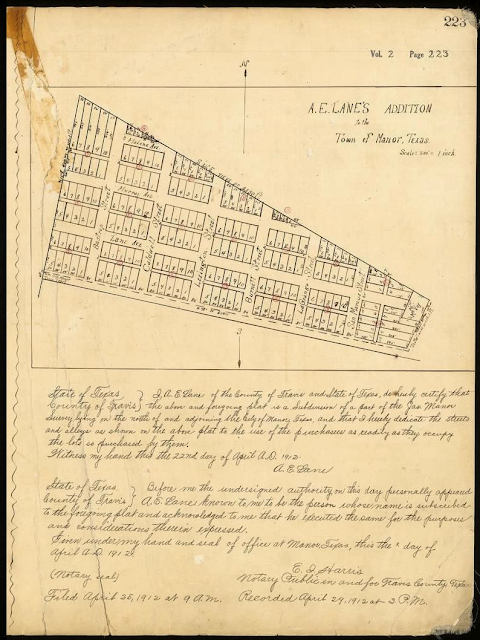
Addison Earldom Lane had purchased 38.75 acres of land from James Manor in 1879. In February, 1897 Martha Bloor bought a piece of this property 250 feet square from A. E. Lane. The purchase price of the land was $1,900. It was just outside of, but adjacent to the town of Manor, bordering on
Rector Street. There were no streets north of Rector Street at that time. The deed record states that Mr. Lane agreed to lay out a street an the north side of the property that was 60 feet wide and also on the east and west sides of the property that were 80 feet wide.
When Mr. Lane officially added his 38.75 acres to the town of Manor in 1912, those east and west
streets became extensions of the already existing Lexington and Caldwell Streets and the street on the north side of the property was named Lane Avenue.
newly acquired land in Texas. Travis County tax assessment records from 1891 show that he owned 700 sheep. News from Manor printed in the June 24,1892 edition of The Austin American newspaper said, "Mr. A. S. Bloor left yesterday for Chicago with two cars of sheep." 1893 Travis County tax assessment records show that he owned no sheep that year.
When the Bloor house was built in 1897, it was actually not in the town of Manor. A man named
Addison Earldom Lane had purchased 38.75 acres of land from James Manor in 1879. In February, 1897 Martha Bloor bought a piece of this property 250 feet square from A. E. Lane. The purchase price of the land was $1,900. It was just outside of, but adjacent to the town of Manor, bordering on
Rector Street. There were no streets north of Rector Street at that time. The deed record states that Mr. Lane agreed to lay out a street an the north side of the property that was 60 feet wide and also on the east and west sides of the property that were 80 feet wide.
When Mr. Lane officially added his 38.75 acres to the town of Manor in 1912, those east and west
streets became extensions of the already existing Lexington and Caldwell Streets and the street on the north side of the property was named Lane Avenue.
The Austin Daily Statesman newspaper printed this on July 19, 1897; 

A contract was signed with Charles P. Ledbetter and work was begun. While most of the homes in Manor were wood frame buildings, the Bloor house was covered in brick that was supplied by the Elgin Press Brick Company, just a few miles down the road in Elgin. The house had 4 chimneys and 7 fireplaces. (most other homes, including that of James Manor had only 1 chimney and 1 or 2 fireplaces, depending on whether they were one or two story buildings)

The Austin Weekly Statesman newspaper followed with this update on August 12, 1897;

 |
| Bloor house - under construction, 1897 |
In addition to the main dwelling, three other buildings were constructed. One was a two-story frame house, 24x40 feet in area which was built as a gymnasium for the children in the family. This building is visible in the 1897 construction photo above.
 |
| Bloor house - gymnasium at the corner of West Lane Avenue and North Caldwell Street |
Another, 18x20 feet in area, was to be the carriage house.
 |
| Bloor house - carriage house on the West Lane Avenue side of the property |
 |
| Bloor house - garden house at the rear of the main house |
A total of 89,77O bricks were purchased for constructing the house - costing $748.10. How do we
Apparently the past-due balance was paid at some time because the Bloor family moved into the
house in 1898. Unfortunately, Alfred Bloor enjoyed the new home only a short time, dying on November 24, 1899. He was buried in the Oakwood Cemetery in Austin.
A family genealogy website says that after Alfred died in 1899, the family returned to Pittsburgh
for a short period of time. The Galveston Daily News printed this on March 19, 1900; "Mrs. A. S.
Bloor and family left this week for Pittsburgh, PA. to spend the spring and summer..."The 1900 U.S.
Census, taken on June 5th, shows Martha and her four sons living at 219 Winebiddle Street, Pittsburgh, PA. This is the former home of Alfred's grandmother, Ann Sutton, where Alfred and his siblings went to live after the death of their parents in 1863-1864.
house in 1898. Unfortunately, Alfred Bloor enjoyed the new home only a short time, dying on November 24, 1899. He was buried in the Oakwood Cemetery in Austin.
A family genealogy website says that after Alfred died in 1899, the family returned to Pittsburgh
for a short period of time. The Galveston Daily News printed this on March 19, 1900; "Mrs. A. S.
Bloor and family left this week for Pittsburgh, PA. to spend the spring and summer..."The 1900 U.S.
Census, taken on June 5th, shows Martha and her four sons living at 219 Winebiddle Street, Pittsburgh, PA. This is the former home of Alfred's grandmother, Ann Sutton, where Alfred and his siblings went to live after the death of their parents in 1863-1864.
They had apparently returned to Manor by at least July 26, 1901 when their son, Grant, age 16, died and was buried in the Oakwood Cemetery Annex in Austin.
 |
| Bloor House, circa 1908 |
$247,196.28. She owed debts of only $6,700.

The house was rented out to various local residents until 1951. At that time Lillian Shockley
bought the house with a deed of trust made out to the Austin National Bank.
In late 1951, Lillian Shockley opened a rest home in the Bloor house. It was called, "Shockley's
Sheltering Arms". She operated the rest home until August, 1953, at which time she sold it to
Chester Foster and it became known as Foster's Rest Home.
bought the house with a deed of trust made out to the Austin National Bank.
In late 1951, Lillian Shockley opened a rest home in the Bloor house. It was called, "Shockley's
Sheltering Arms". She operated the rest home until August, 1953, at which time she sold it to
Chester Foster and it became known as Foster's Rest Home.
 |
| The Elgin Courier newspaper, August 20, 1953 |
 |
| The Elgin Courier newspaper, August 28, 1952 |
The dates are not exactly clear, but at some point the Bloor house was placed in trust with the
Austin National Bank and when Bertram H. Bloor, Sr. died November 18, 1953, the house was
inherited by his son and daughter, Bertram H. Bloor, Jr. and Anne Shryver. In 1960 they sold the
house to Thomas and Anne Bowdy. That ended the Bloor family connection to the house.
The Bowdy's sold the house to Sidney and Evelyn Donnell in 1977. In 1982, the Donnell's
submitted an application to the Texas Historical Commission for a historical marker for the house.
The application was approved on January 7, 1983. The marker is fastened to the outside wall near
the front door. It says;
inherited by his son and daughter, Bertram H. Bloor, Jr. and Anne Shryver. In 1960 they sold the
house to Thomas and Anne Bowdy. That ended the Bloor family connection to the house.
The Bowdy's sold the house to Sidney and Evelyn Donnell in 1977. In 1982, the Donnell's
submitted an application to the Texas Historical Commission for a historical marker for the house.
The application was approved on January 7, 1983. The marker is fastened to the outside wall near
the front door. It says;

"Local rancher and farmer Alfred Sutton Bloor (1850-1899) and his wife Martha (Wainwright) (1849-1928), natives of Pennsylvania, built this home in 1897-1898. Constructed by the Elgin Press Brick Co., the house features characteristics of the Queen Anne and Colonial Revival styles. Outstanding features include the turreted corners and the massive portico. A landmark in the Manor community, the house remained in the ownership of the Bloor family until 1960."
Information on the historical marker is correct, but there are a number of details on the application that are not correct.
The application says; "The owners of the land upon which Bloor House was built were a few of the outstanding citizens and pioneers of Travis County. These citizens and their land eventually became a part af the municipality of Manor, Texas founded in 1912".
(1) There were only 2 owners of the land before Martha Bloor - James Manor and A. E. Lane.
(2) Manor was founded in 1872 - A. E. Lane added his land to Manor in 1912.
The application says; "a resume of the owners of this land begins in 1844".
Actually the list of previous owners begins in 1838 when James Manor received his land grant for
1280 acres and had the land surveyed on November 12, 1838.
The application says; "Judge Townes died in 1871 before all of his land title recards were
completed.'" ----- Judge Townes actually died in 1864.
The application says; "The executor of Judge Eggleston's estate transferred the title....."
(1) There were only 2 owners of the land before Martha Bloor - James Manor and A. E. Lane.
(2) Manor was founded in 1872 - A. E. Lane added his land to Manor in 1912.
The application says; "a resume of the owners of this land begins in 1844".
Actually the list of previous owners begins in 1838 when James Manor received his land grant for
1280 acres and had the land surveyed on November 12, 1838.
The application says; "Judge Townes died in 1871 before all of his land title recards were
completed.'" ----- Judge Townes actually died in 1864.
The application says; "The executor of Judge Eggleston's estate transferred the title....."
It should say Judge Towne's estate.
The application says; "Nelson Rector received title to part of the estate in 1873, and he sold
this part to James Manor in 1877. This became part of the 'James Manor Headright Survey'."
Nelson Rector never owned any part of this land. It had belonged to James Manor since 1838.
The application says; M.C. (Martha Cousins) Townes purchased the property from the estate of
her deceased husband, Eggleston D. Townes in 1871 and the deed was recorded in "Volume 5,
page 514" of the Travis County Deed Recerds. Actually it was recorded in Volume V, page 514.
They must have misinterpreted the "V" as a Roman numeral and converted it to the number 5.
The application says; "In 1881 James Manor sold 38.75 acres to A.E. Lane." The deed for the
sale is dated November 29, 1879.
The application says; Martha Bloor purchased the land where they built the house on "August 3,
1897". The deed was filed in the Travis County Clerk's office on August 3rd, but the deed itself does
not give a month or day when it was signed, only the year of 1897. The Notary Public who verified
the signing of the deed dated his record June 30, 1897. That's just over a month earlier than the
application shows.
And there are several names that are misspelled. A. C. Caldwell's first name, Charles Chevaillier's
last name, and Nathaniel Amory's last name are all misspelled.
These are some of the small errors in the application, but there is one huge error. The application
shows six owners of the land before James Manor. All of those transactions are from the A.C.
Caldwell land grant, not from the James Manor land. This means that the first six owners listed in the application had no connection whatsoever to the land where the Bloor House was built and should not have been included in the application.
The application says; "Nelson Rector received title to part of the estate in 1873, and he sold
this part to James Manor in 1877. This became part of the 'James Manor Headright Survey'."
Nelson Rector never owned any part of this land. It had belonged to James Manor since 1838.
The application says; M.C. (Martha Cousins) Townes purchased the property from the estate of
her deceased husband, Eggleston D. Townes in 1871 and the deed was recorded in "Volume 5,
page 514" of the Travis County Deed Recerds. Actually it was recorded in Volume V, page 514.
They must have misinterpreted the "V" as a Roman numeral and converted it to the number 5.
The application says; "In 1881 James Manor sold 38.75 acres to A.E. Lane." The deed for the
sale is dated November 29, 1879.
The application says; Martha Bloor purchased the land where they built the house on "August 3,
1897". The deed was filed in the Travis County Clerk's office on August 3rd, but the deed itself does
not give a month or day when it was signed, only the year of 1897. The Notary Public who verified
the signing of the deed dated his record June 30, 1897. That's just over a month earlier than the
application shows.
And there are several names that are misspelled. A. C. Caldwell's first name, Charles Chevaillier's
last name, and Nathaniel Amory's last name are all misspelled.
These are some of the small errors in the application, but there is one huge error. The application
shows six owners of the land before James Manor. All of those transactions are from the A.C.
Caldwell land grant, not from the James Manor land. This means that the first six owners listed in the application had no connection whatsoever to the land where the Bloor House was built and should not have been included in the application.
 |
| Bloor house - historical marker application, pages 14 & 15 Highlighted area should not have been part of the application. |

Sources
Photographs of Alfred and Martha Bloor, and painting of the Old Bloor Cabin, graciously provided by Carol Schryver-Bloom, great granddaughter of Alfred and Martha Bloor
Bloor family genealogical information taken from "Our Genealogy" website -
Travis County Deed Records found online on The Portal to Texas History
Travis County Probate Records found online on The Portal to Texas History
The Elgin Courier newspaper found online on The Portal to Texas History
Bloor house historical marker application found online on The Portal to Texas History
Bloor family genealogical information taken from "Our Genealogy" website -
https://www.laurellynn.com/genealogy/bloor/james_bloor____James_H.htm
Richard B. Sutton appointed guardian of minors - Allegheny County, PA. Orphans Court Docket, Book 19, page 185, March Term, 1864 - December Term, 1864
Alfred S. Bloor enrolled in high school - My
High
School
Days
: Including
a brief history of the Pittsburgh Central High School from 1855 to
1871 and addenda, / Geo. T. Fleming, 1904,
page 130
James Holbrook Bloor's absence explained in Allegheny County, PA. Orphans Court Docket, Book 22, pages 161-163, December Term, 1866 - September, 1867
Bloor family information from Pennsylvania taken from FamilySearch.org - Full Text experimental pages
Bloor family information from Pennsylvania taken from FamilySearch.org - Full Text experimental pages
Ann Sutton, Last Will and Testament, Allegheny County, PA., number 79 in Will Book 35, pages 156-161
handwritten will - https://www.familysearch.org/ark:/61903/3:1:3QS7-L9SW-Q3S9?view=fullText
Ann Sutton - application for Letters Testamentary by Theodosia Bloor, May 18, 1889, Allegheny County, PA. Death Record, Book 7, page 20
John R. Cooper, Ella W. Cooper and Elvira Wainwright in Austin, TX – March 25, 1878, Allegheny County, PA. Deed Book 388, page 335
John R. Cooper and Ella W. Cooper living in Austin, TX. - April 5, 1878 – Allegheny County, PA. Powers of Attorney, Book 11, pages 172-173
William L. Abbott appointed guardian of Paul Cooper – January 10, 1880, Allegheny County, PA. Orphans Court Docket 1879-1880, Volume 42, page 240
Travis County Deed Records found online on The Portal to Texas History
Travis County Probate Records found online on The Portal to Texas History
The Elgin Courier newspaper found online on The Portal to Texas History
Bloor house historical marker application found online on The Portal to Texas History